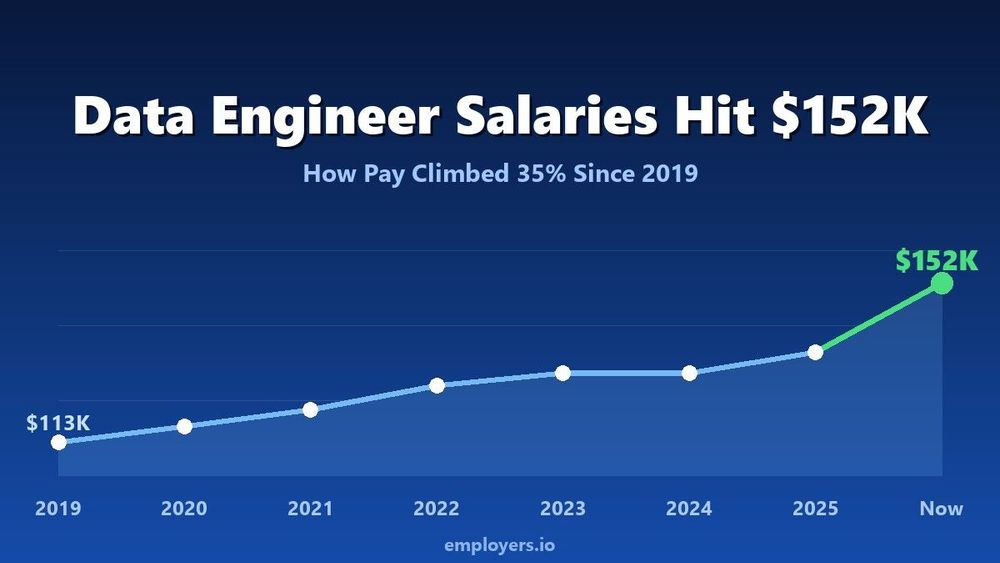
A data engineer in the US earns $152K a year on average right now. Back in 2019, the median sat at $113K. That's a 35% climb in seven years, and the most interesting part of the story is how uneven that climb has been.
From $113K to $152K: what actually happened
Year by year, here's how national median pay for data engineers has moved:
| Year | Median pay |
|---|---|
| 2019 | $113K |
| 2020 | $117K |
| 2021 | $121K |
| 2022 | $127K |
| 2023 | $130K |
| 2024 | $130K |
| 2025 (projected) | $135K |
| Today (live listings) | $152K |
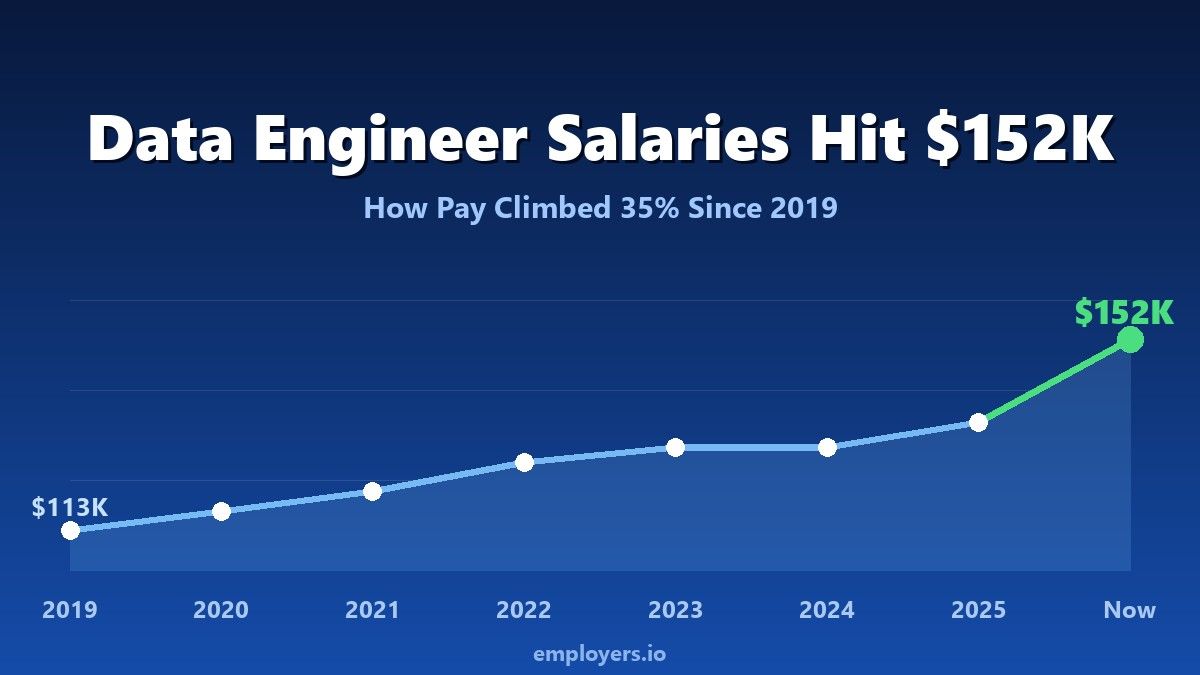
The 2019 to 2024 figures come from the US Bureau of Labor Statistics, and they tell a story of steady, almost boring growth: roughly $4K to $6K added every year while companies quietly built out their data teams.
Then something changed. Pay flattened completely between 2023 and 2024, stuck at $130K while the tech job market absorbed layoffs and hiring freezes. If you were a data engineer during those two years, you probably felt it.
And now the rebound. Current US job listings put the average at $152K, well above the $135K you'd expect if pay had simply kept growing at its old pace. That gap between the projected trend and what employers are actually offering today is the AI effect in one number. Every company racing to ship AI features needs pipelines, warehouses, and clean data first, and data engineers are the people who build all of it.
Who pays the most right now
The surprise at the top of the list isn't a Silicon Valley tech giant. It's a bank.
- Capital One: $215K/yr
- Intuit: $213K/yr
- Dropbox: $179K/yr
- Meta: $178K/yr
- Square: $171K/yr
- Databricks: $170K/yr
- Stripe: $160K/yr
- Box: $152K/yr
- Amazon: $149K/yr
- Shopify: $137K/yr
Capital One paying 41% above the national average, and ahead of Meta by almost $40K, says a lot about where data engineering demand has spread. Finance and fintech companies (Capital One, Intuit, Square, Stripe) hold four of the top seven spots. Amazon, despite hiring constantly, actually pays slightly below the national average.
Experience changes everything
The averages hide a wide spread. Entry-level data engineers start around $92K, experienced ones average $174K, and the top 10% clear $215K. The bottom 10% of the market sits at $51K, usually smaller companies in lower-cost states.
Location plays the same role it always has. California leads the country, and the usual coastal suspects (Washington, New York, Massachusetts) plus DC round out the top of the state rankings, helped by cost of living and state wage laws.
Where this goes next
The Bureau of Labor Statistics projects 7% employment growth for the field between 2024 and 2034, faster than the average across all occupations. And compared to neighboring roles, data engineering holds up well: data scientists average $135K, data analysts $109K, and software engineers $145K. Among data roles, only machine learning engineers ($169K) earn more, and the two jobs increasingly overlap anyway.
If the last two years proved anything, it's that data engineering pay tracks the infrastructure behind the hype rather than the hype itself. Model releases come and go. The pipelines that feed them still need someone to build and maintain them.
All the numbers above come from our Data Engineer Salary Guide on Job-Applications.com, which combines real job listings with US Bureau of Labor Statistics wage data and gets updated as new listings come in. If you want to see what a specific company or state pays, the full guide breaks it down.